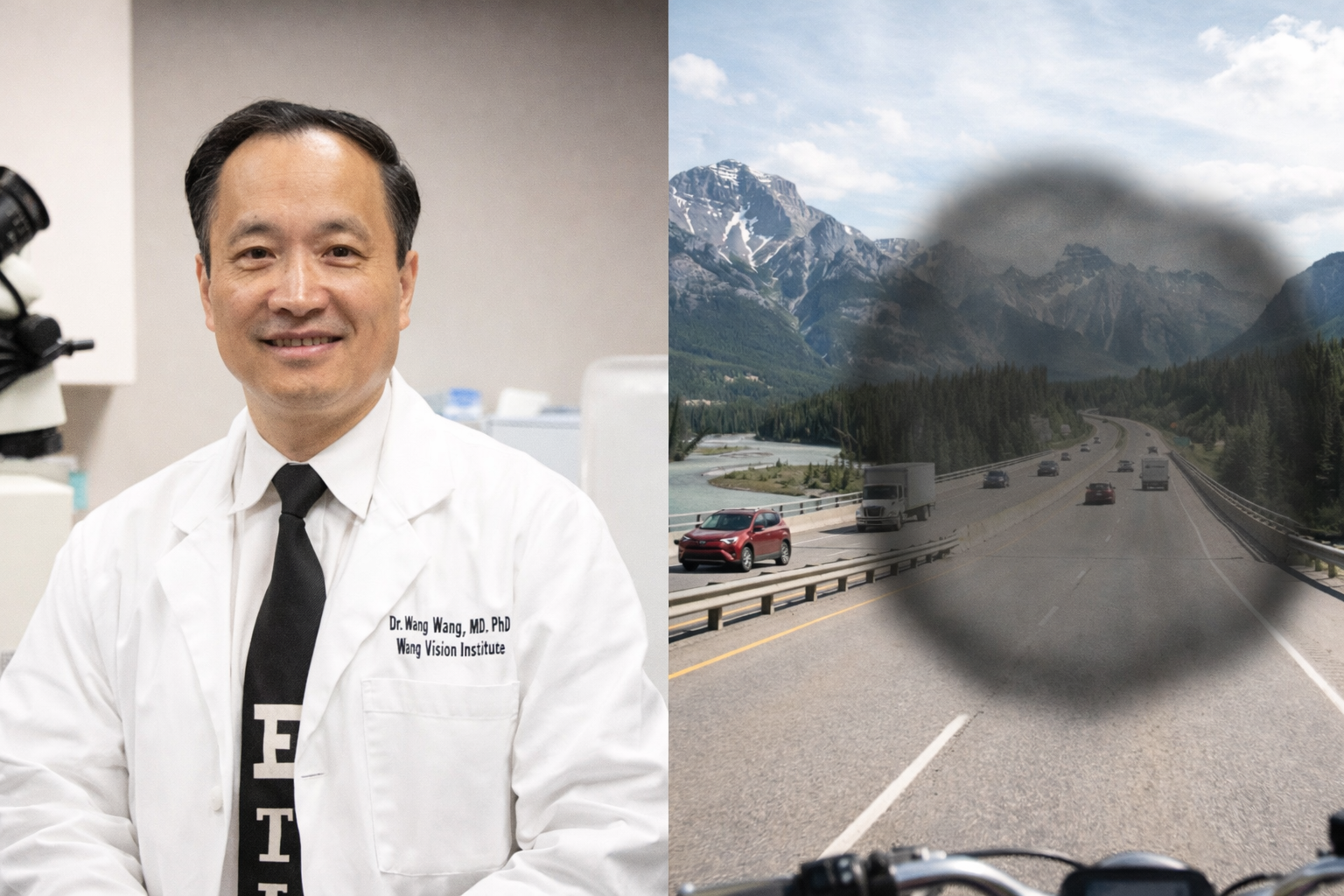

Do Any of These Feel Familiar?

  • Even after following your doctor’s recommendations… your vision still seems to decline
  • You’ve tried supplements or treatments… but nothing seems to stop the progression
  • You were diagnosed with macular degeneration and told it may slowly progress over time.
  • Reading has become harder than it used to be — even with stronger glasses.
  • You sometimes notice a blurry or faded area in the center of your vision.
  • Faces still look familiar, but recognizing details has become more difficult.
  • You need much more light to comfortably read books, menus, or your phone.
  • Straight lines — door frames, blinds, or text on a page — sometimes appear slightly distorted.
  • Deep down, you worry your vision may continue getting worse… and that you could eventually lose your independence.

For many people, this raises an uncomfortable question: “Why does my vision keep getting worse… even when I’m doing everything right?”

According to Dr. Ming Wang, the answer may lie in a hidden factor that many standard treatments simply don’t address.

And once you understand what’s really happening, it may completely change how you look at your condition — and what you choose to do next.

WRITTEN BY THE SPECIALIST

Dr. Ming Wang

Harvard-trained Ophthalmologist • Professor at Johns Hopkins

Dr. Ming Wang holding his book
Amazon Best-Selling Author
“From Darkness to Sight”

Dr. Ming Wang is a Harvard-trained ophthalmologist with years of clinical experience and a long-standing teaching role at Johns Hopkins.

He has personally guided 21,000+ patients dealing with age-related macular degeneration (AMD), dry AMD, wet AMD, glaucoma, and diabetic retinopathy — including many who were told there was “nothing more that could be done.”

But what he shares in this presentation didn’t come from a textbook. It began when someone he loved started losing their independence — and the situation kept getting worse.

In 2019, Dr. Wang’s father was diagnosed with wet AMD. What followed was a long stretch of frequent eye injections that slowed the damage… but didn’t stop it.

Not just as a doctor.
But as a son.

Night after night, he returned to the clinical research — searching for answers to a question that troubled him deeply:

Why does vision continue to decline for so many people… even when they follow the standard medical recommendations?

What he eventually uncovered challenged everything he thought he knew about how vision loss progresses — and revealed a hidden factor that may help explain why so many patients continue to decline… even when following standard treatment protocols.

Today, he explains exactly what he uncovered — and why so many patients say it helped them protect their independence without injections or surgery.

She Thought This Was Just Part of Aging. It Wasn’t.

“I told myself I could live with it.
But the day I struggled to see my grandson’s face clearly…
I realized this wasn’t just ‘getting older.’”

Older woman reading at home while dealing with vision problems

She did everything she was told to do.

Regular appointments.
Supplements.
Following every recommendation as carefully as she could.

And yet… little by little, her vision kept getting worse.

At first, it was subtle. But slowly, a faint dark spot began appearing in the center of her vision — especially when she tried to read.

Each morning when she opened her Bible, parts of the words in the middle of the page seemed to fade or disappear behind that shadow.

She tried stronger glasses.
She followed the supplements her doctor recommended.
She told herself this was just part of aging.

But deep down, something didn’t feel right.

Because even after doing everything “right”… her vision continued to decline.

Driving at night quietly disappeared from her routine, and she stopped mentioning how much harder simple things were becoming.

Her doctor explained that age-related macular degeneration often progresses over time, and that if it advanced further, treatments like injections might eventually be necessary.

The thought of that made her deeply uncomfortable.

She couldn’t stop wondering: “Why is this still getting worse… even though I’m doing everything I’m supposed to?”

Until one day, her daughter sent her a video about Dr. Ming Wang’s research.

She almost ignored it.

But something made her watch.

In that presentation, she heard something she had never heard before — that there may be a hidden factor silently accelerating vision decline, one that many standard treatments simply don’t address.

Curious, she decided to follow the approach explained in the presentation.

Within a few weeks, she began noticing small but meaningful changes.

When she opened her Bible, the dark shadow in the center of the page didn’t seem to cover the words the way it used to.

Reading felt easier.

She felt more confident walking outside — and for the first time in a long time… she felt hopeful again.

— Sarah M., 68

Older woman reading at home while dealing with vision problems
▶ Watch The Video That Changed Everything

You’re Not Alone in Asking These Questions.
Here Are Clear, Straightforward Answers.

01. I’ve already tried vision supplements and nothing worked. Why would this be any different?

Many supplements focus primarily on slowing progression rather than addressing underlying factors that may contribute to ongoing decline.

02. My ophthalmologist never mentioned this. Should I be concerned?

Not at all.

Most eye specialists are trained to manage and stabilize symptoms using established treatment guidelines. This research looks at a different biological pathway — one that isn’t typically part of conventional training.

That doesn’t mean your doctor is wrong. It simply means this approach comes from a different angle.

03. Is this only for early-stage macular degeneration?

No.

The research does not set a strict “cutoff point” based on how much vision has already been lost. Many individuals with moderate to more advanced deterioration have still reported meaningful improvements in clarity, contrast sensitivity, or stability.

If there is still functional vision present, there is still something to support.

04. How do I know this isn’t just another online health trend?

That’s a fair question.

Dr. Wang is a Harvard-trained ophthalmologist and long-standing professor with decades of clinical experience. His presentation explains the scientific reasoning behind the protocol, the clinical observations that led to it, and why it differs from typical supplement marketing.

You can evaluate the information yourself inside the presentation.

05. I was told there’s no cure for macular degeneration. Is that still true?

Conventional medicine has no cure - and that's accurate. But "no cure" was based on what existing treatments could do. This research explores a different biological pathway — one that may complement traditional approaches rather than replace them.

06. How long will this presentation be available?

Because of the clinical research and educational material involved, the presentation is not intended to remain publicly available indefinitely.

Access may be limited based on demand and platform restrictions, so if you’re interested, it’s recommended to watch while it’s still accessible.